Turning Bitcoin into Electricity for Families in Africa
For years, the mainstream media has repeated a single, damaging narrative about Bitcoin: “It wastes energy.” We’ve all seen the headlines claiming that Bitcoin mining boils the oceans or consumes as much power as a small country.
But while the world was busy arguing, a company called Gridless Compute was building. And what they have built isn’t just a rebuttal to the critics; it is a blueprint for Africa’s energy future.
This week at the Africa Bitcoin Conference, Gridless was rightfully crowned the African Bitcoin Miner of the Year. Their achievement wasn’t based on hash rate or profit margins, but on a metric that matters far more: impact.
Gridless has proven that Bitcoin mining is not an energy parasite. When deployed strategically, it is an engine for abundance.
The Energy Paradox of Africa
To understand why Gridless matters, it is essential to comprehend the energy paradox of rural Africa.
Across the continent, there are thousands of potential sites for renewable energy – hydroelectric potential in rivers, solar potential in deserts. But building a power plant in a remote village is economically risky. Why? Because the local community, while desperate for power, often cannot consume enough electricity immediately to pay back the cost of building the infrastructure.
It’s a chicken-and-egg problem: You can’t build the grid because there’s no demand to pay for it, and there’s no demand because there’s no grid.
This is where millions of families get stuck in the dark.
Enter the “Buyer of Last Resort”
Gridless solves this by introducing a new economic actor: the Bitcoin Miner.
A Bitcoin miner is unique because it is a location-agnostic buyer of electricity. It can be plugged in anywhere, runs 24/7, and pays for power instantly.
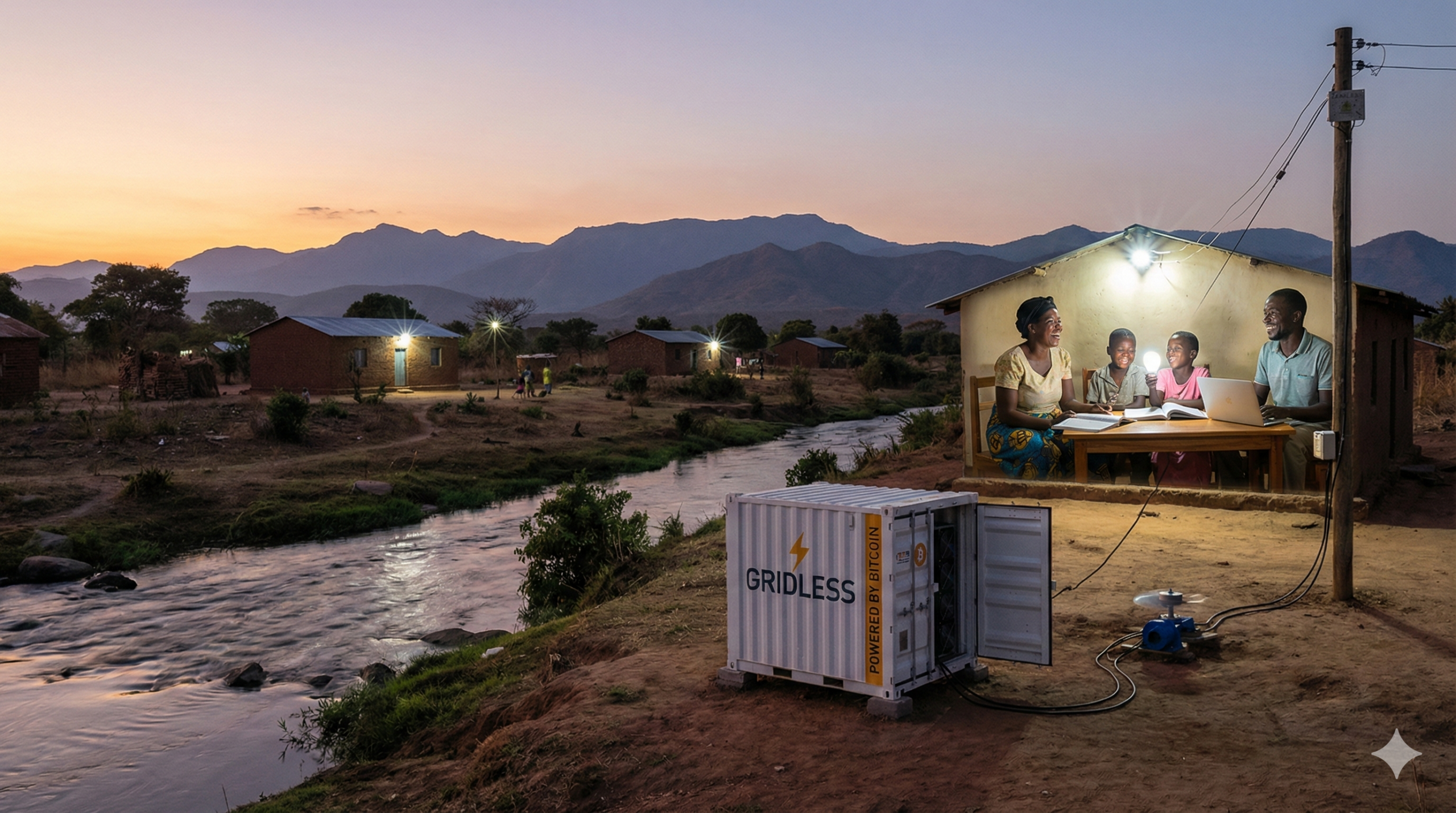
Gridless partners with renewable energy developers (like hydro mini-grid operators) and says, “Build the plant. Whatever power the village doesn’t use, we will use to mine Bitcoin.”
Suddenly, the economics change. The power plant has a guaranteed customer from the beginning. This lowers the risk for investors, making the project viable. The revenue from mining subsidizes the cost of the electricity, making it cheaper for the local families.
It is a symbiotic relationship. Bitcoin gets secured by clean, stranded energy. The community receives reliable, affordable power.
From Kenya to the Continent
Gridless started this model in Kenya, but in 2025, it was expanded to the continent. Their expansion into Malawi and Zambia has demonstrated that this wasn’t a one-off experiment. It is a scalable solution.
In Malawi, a nation struggling with grid instability, Gridless sites are acting as anchors for new renewable infrastructure. In Zambia, they are helping to monetize rural hydro resources that were previously wasted.
This is what Direct Electrification looks like. It isn’t a government promise or an NGO charity project. It is a business model where Bitcoin incentives align perfectly with human needs. Hundreds of families who lived in darkness now have light to study by, power to run small businesses, and access to the digital economy.
Decentralized Innovation
Perhaps the most exciting part of Gridless’s work in 2025 has been their move toward Decentralized Innovation. They aren’t just building massive industrial sites; they are developing ways for small-scale solar operators – such as local farmers – to monetize their excess energy.
Imagine a farmer with solar panels to run an irrigation pump. When the pump isn’t running, that energy is wasted. Gridless is building the tools to let that farmer plug in a small miner and turn that sunlight into satoshis.
The “energy FUD” (Fear, Uncertainty, Doubt) is dead. Gridless has killed it with proof of work.
Gridless has sent a signal to the world: Africa is not just adopting Bitcoin; we are evolving it. We are using it to address our most fundamental challenge – energy access – and in doing so, we are showing the rest of the world what the future of green infrastructure looks like.
The next time someone tells you Bitcoin is bad for the environment, tell them about Gridless. Better yet, if you are an energy developer in Africa with stranded power, stop wasting it. Reach out to the Green Africa Mining Alliance (GAMA) and turn that waste into wealth.